How humans and AI should work together in critical care
Data scientists and clinicians provide their perspectives on how humans and AI can safely work together in intensive care units.
While AI is transforming how the entire software industry works, adoption in more risk-averse industries such as clinical practice lags behind. One major obstacle is that AI-based systems fail to account for the broad sociotechnical system in which humans and AI collaborate: advancements in AI must be accompanied by building human competencies. Contrary to popular belief, more capable systems do not necessarily reduce human effort or errors, and may paradoxically even lead to increased demands for highly skilled personnel. Another major issue is a lack of transparency in today’s black-box AI systems, which raises the question of who should be responsible for the system’s outcomes.
This study tackles the question of how humans working in intensive care units (ICUs) can effectively collaborate with AI based on surveys and interviews with (I’d say, a fairly large number of) data scientists and clinicians.
The study covers four levels of automation in which AI:
- does not provide real value over humans
- can improve human performance, but humans are always needed
- could act alone, but human input increases reliability
- is able to fully automate tasks without human input
For six core ICU tasks:
- monitoring patient data
- documenting clinical information
- analysing medical data
- prescribing medication or treatment
- diagnostic decision-making
- interacting with patients.
Data scientist perspective
About 72% of surveyed data scientists agree that AI could eventually fully automate monitoring of patient data. AI is especially suited for this task because even experienced clinicians are overwhelmed with the amounts of data that must be monitored. Moreover, occasional system failures are unlikely to cause patients to die.
A large majority of data scientists also agree that AI could eventually automate documentation of clinical information – a task which many clinicians find boring – although human assistance would increase reliability.
Something similar can be said about automating the generation of analysis reports of medical data, which would enable clinicians to focus fully on interpreting analyses.
Things start to get a bit trickier when it comes to prescribing medication or treatment. Most data scientists agree that this task can be supported by AI, but would always require humans in the lead to ensure that suggestions are approved by a medical professional who is accountable and takes legal liability.
The same arguments hold for diagnostic decision-making: many data scientists have social and ethical concerns about augmenting diagnostic decision-making with AI, even if it is technologically feasible to do so. Some also feel that using AI for this would undermine physicians’ role identities.
Regarding interaction with patients, there is strong agreement that this is not something that should be augmented or automated by AI, based on social concerns and what it means to be human.
Clinician perspective
Like the surveyed data scientists, clinicians acknowledge the benefits of automating tasks, as long as systems are highly reliable. Otherwise they would have to constantly supervise the AI, which defeats the whole purpose of saving time.
Clinicians are particularly hopeful about a future in which clinical documentation is fully automated, and only needs to be checked for potential errors.
They agree with the data scientists when it comes to analysis of medical data and prescription of medication or treatment: the ultimate decision power must remain with humans and doing otherwise is dangerous.
However, whereas data scientists believed that clinicians would be worried about loss of status or power if diagnostic decision-making were automated, not a single clinician voiced such concerns. Instead, they focused entirely on the benefits that AI could bring to patients. Their only real worry appears to be that medicine cannot be generalised, and each patient must be assessed as a unique human being.
Finally, clinicians again agree with data scientists that interaction with patients should be left to humans. For many clinicians, interaction with patients is one of the reasons why they chose their professions, and they hope that AI can help them invest more time in it.
Summary
-
AI should automate boring administrative tasks such as documentation and reporting
-
AI can automate or support clinical tasks involving a lot of data
-
AI should never be used to augment or automate interaction with patients
You might also like

The Toilet Paper
Finding the data unicorn: A hierarchy of hybridity in data and computational journalism
How is data journalism treated in Canada’s legacy news organisations?

Captain’s Blog
COPTCHA: A Completely Original Public Turing test to tell bad Cops and Humans Apart
COPTCHA is a proof of concept for an online tool that your app can use to deny service to morally corrupt police officers.
The Toilet Paper
Is that my legitimate interest or your legitimate interest?
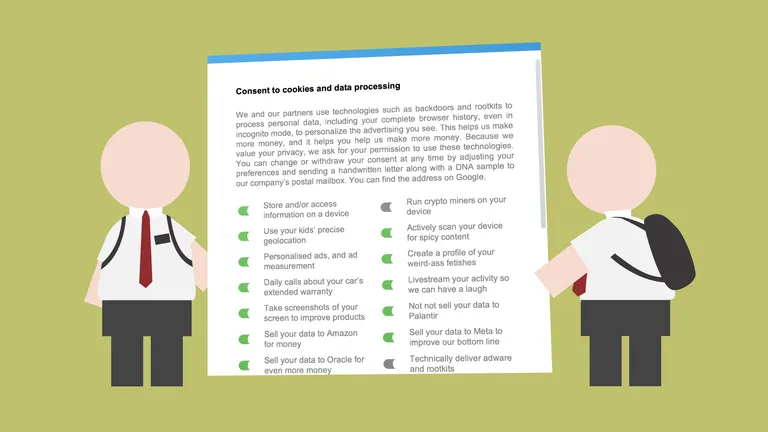
Websites are allowed to collect user data without explicit consent, if they follow all the rules – but they often don’t.

The Toilet Paper
When machine learning meets software engineering
Software engineering and machine learning are like oil and water. They don’t mix – unless you add an emulsifier of course.

Getting Around
Using data to improve your bus and train rides
A non-exhaustive list of public transport projects I was part of throughout the years.

The Toilet Paper
Truth is a lie: Crowd truth and the seven myths of human annotation
There’s no such thing as the truth, so it makes no sense to treat human annotations as either right or wrong.